
Habari
SERIKALI YATANGAZA NEEMA KWA WAKULIMA KUPITIA VISIMA VYA UMWAGILIAJI

📍 Njedengwa - Dodoma.
The Government is continuing the implementation of its strategy to increase agricultural productivity after distributing irrigation pumps to farmer groups and drilling 390 wells across 15 regions, a move expected to enable farmers to cultivate year-round and boost crop production.
This measure will benefit 15,022 farmers through 769 groups, while an area of 13,518.75 acres is expected to transition to irrigation farming, reducing reliance on rain-fed agriculture.
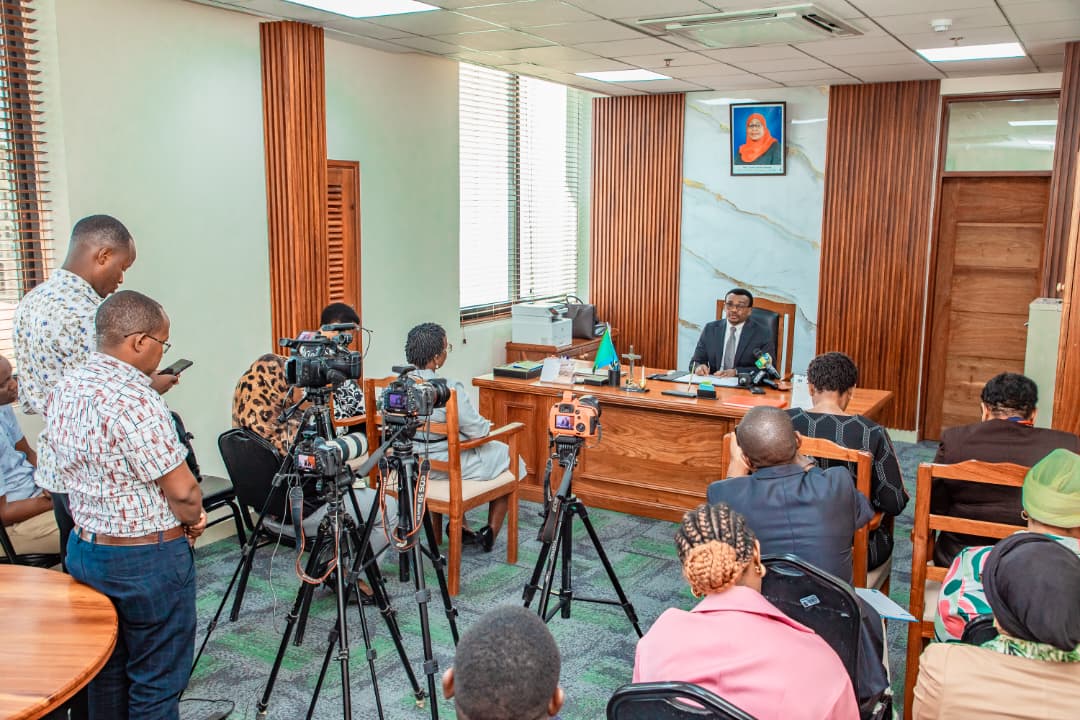
Speaking to journalists in Dodoma, the Director General of the National Irrigation Commission (NIRC), Raymond Mndolwa, stated that alongside continuing the construction of standard and strategic irrigation projects, the Commission is actively implementing its strategy to boost agricultural productivity by distributing irrigation pumps to farmer groups and drilling 390 wells across 15 regions.
This step is expected to enable farmers to cultivate year-round and boost crop yields.
He said the plan fulfills government directives to empower smallholder farmers economically, particularly women and youth, by guaranteeing reliable water access.
"We have been directed to find ways that will enable low-income citizens to increase their income. That is why, alongside major irrigation projects, we have begun drilling wells and distributing pumps to smallholder farmers," he said.
He noted that these pumps are specifically intended for farmers cultivating near rivers and lakes to help them engage in environmentally friendly agriculture and increase production.
Mndolwa stated that out of the 2,000 pumps procured by the Government, 1,000 pumps have already been received and dispatched to the regions of Mwanza, Mara, Kagera, Kigoma, Simiyu, Geita, and Katavi to begin operation.
He explained that these pumps will be distributed to 769 farmer groups, benefiting 6,335 women and 8,702 men, bringing the total number of beneficiaries to 15,022.
"These pumps will help farmers move away from dependence on rain and enable them to farm across all seasons of the year, which will increase their production and income," he said.
Mndolwa stated that so far, the Commission has drilled 390 wells across 15 regions, with Dodoma leading with 93 wells, followed by Manyara and Tabora with 44 wells each, Geita 42, Singida 32, Njombe 30, Tanga 22, Iringa 20, and Mara and Morogoro with 17 wells each.

He listed other benefiting regions as Pwani and Arusha with 10 wells each, Mtwara with eight, Mbeya with seven, and Ruvuma with five wells.
He mentioned that the Government has also initiated the procurement of 500 pumps for these wells, where 100 pumps have already been received, another 100 are en route from the manufacturer, and 300 pumps are in the procurement stage.
Apart from these pumps, he stated that the Government expects to receive another 1,000 solar-powered pumps, which will be distributed to areas facing electricity supply challenges to expand the scope of irrigation agriculture.
He clarified that wells are drilled on farmers' lands after they are organized into groups, but remain public property to ensure all group members benefit equally and to guarantee the sustainability of the service.
Furthermore, he noted that all benefiting groups are registered in accordance with the law to facilitate the management of these projects and the collection of government revenues.
Mndolwa said the implementation of this project is also expected to generate employment for over 4,000 youth who will participate in the installation, operation, and management of irrigation systems, while emphasizing that the Government's objective is to ensure irrigation becomes a catalyst for agricultural revolution, food security, and economic growth for citizens.